How Good Is AI at Translating Swahili, and Sheng?
I put four translators through Swahili, from proverbs and harambee to the hard noun-class grammar and Kenyan Sheng. The accuracy is quietly excellent. The understanding is a different story.

Eddie Ochieng
October 2, 2026· Updated Oct 2, 2026
Swahili is spoken by well over a hundred million people across East Africa, and it is still treated by most "best AI translator" coverage as an afterthought, when it appears at all. The benchmarks are French and Spanish; the real question, for the rest of us, is how these tools cope with a language they were not built around. So as a native speaker I stopped testing them on European languages and pointed them at Swahili properly, at proverbs, at culturally loaded words, at the language’s notoriously hard grammar, and at Kenyan Sheng. The result surprised me twice, once pleasantly and once in a way that matters.
How I tested
A hands-on test in October 2026, with me judging the Swahili output as a native speaker. All four tools, DeepL, Google Translate, ChatGPT and Claude, saw the same passages. Claude was on its paid Pro tier (Opus 5.5); the rest were free.
First Surprise, the Coverage Is Finally There
The headline most people still believe is that serious machine translation stops at the major European languages. It no longer does. DeepL, the tool everyone files under "European languages only", not only offers Swahili now but handles it genuinely well. Google has long covered it, and the large models treat it as a first-class citizen. The era of Swahili being an afterthought in machine translation has, quietly and without much announcement, ended. That alone is worth saying out loud.
Second Surprise, the Accuracy Is Genuinely Good, Even on the Hard Grammar
Swahili’s reputation for difficulty rests largely on its noun classes: nouns fall into classes, and the adjectives, numbers and verbs around them all have to agree with that class. It is exactly the kind of thing you expect machine translation to fumble. I gave them "These seven beautiful children are playing with their two small dogs", a sentence loaded with agreement traps, and they handled it. Both Google and Claude produced correct agreement throughout, including the genuinely subtle bit, that "mbwa" (dog) belongs to the N-class but takes animate agreement because it is an animal. On raw accuracy, even here, these tools are better than their reputation.
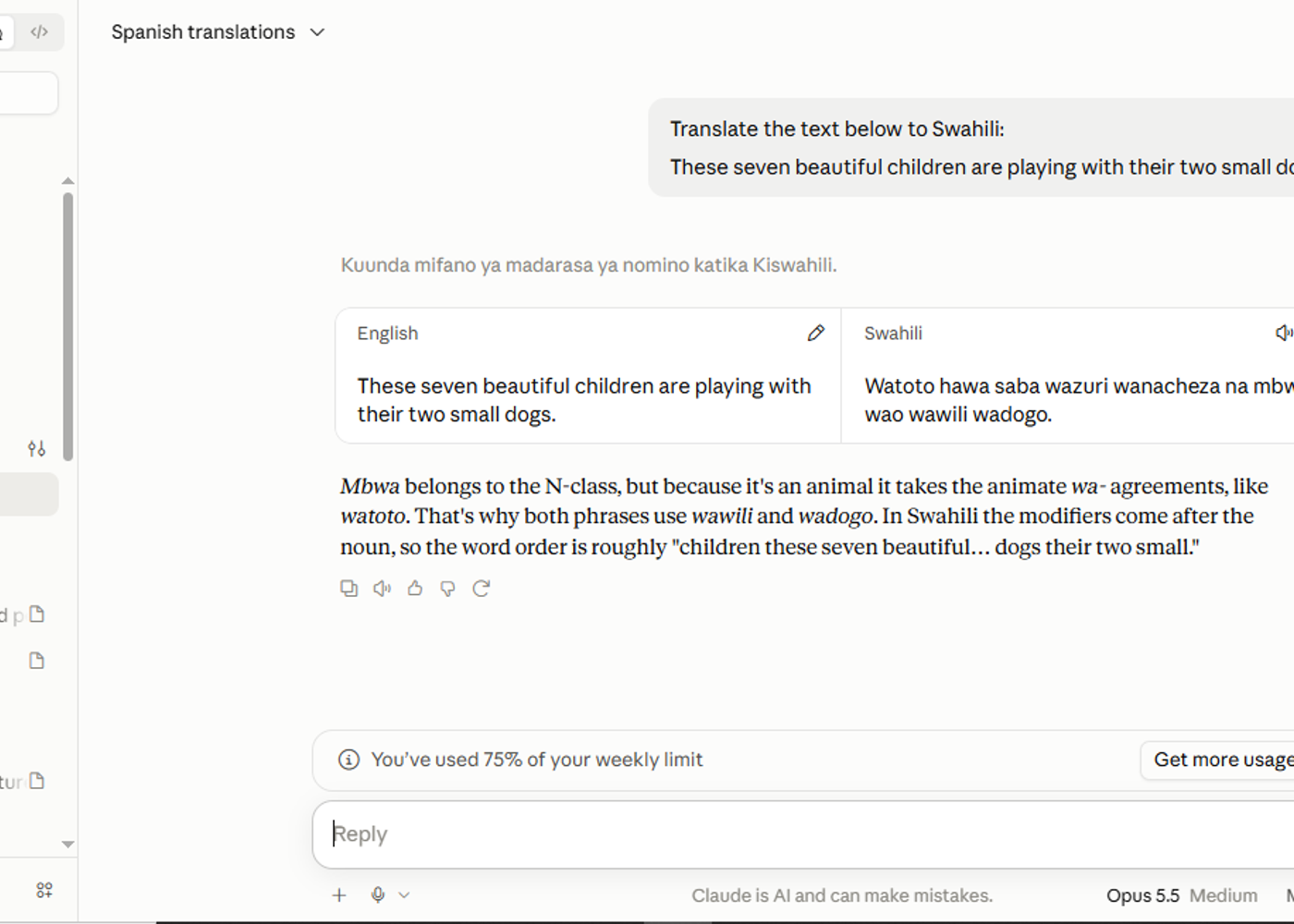
Notice what Claude did beyond getting it right: it explained the grammar, the N-class, the animate agreement, even the word order. Hold that thought, because it is the whole story.
Where They Split, Understanding the Culture
Accuracy, it turns out, is now table stakes. But accuracy was never the hard part of translating Swahili, because so much of the language lives in cultural weight that a correct word-swap flattens. This is where the four tools stopped being interchangeable.
Take "harambee", in the sentence "Harambee ni roho ya jamii." Google translated it cleanly as "Harambee is the spirit of the community", keeping the word, which is correct and completely surface-level. Claude translated it too, and then explained that harambee has no exact English equivalent, that it means "let’s all pull together", communal self-help and pooling effort for a shared cause, that it is Kenya’s national motto, and that "roho" could be rendered as spirit or heart. One tool gave me the words. The other told me what they mean to the people who use them.
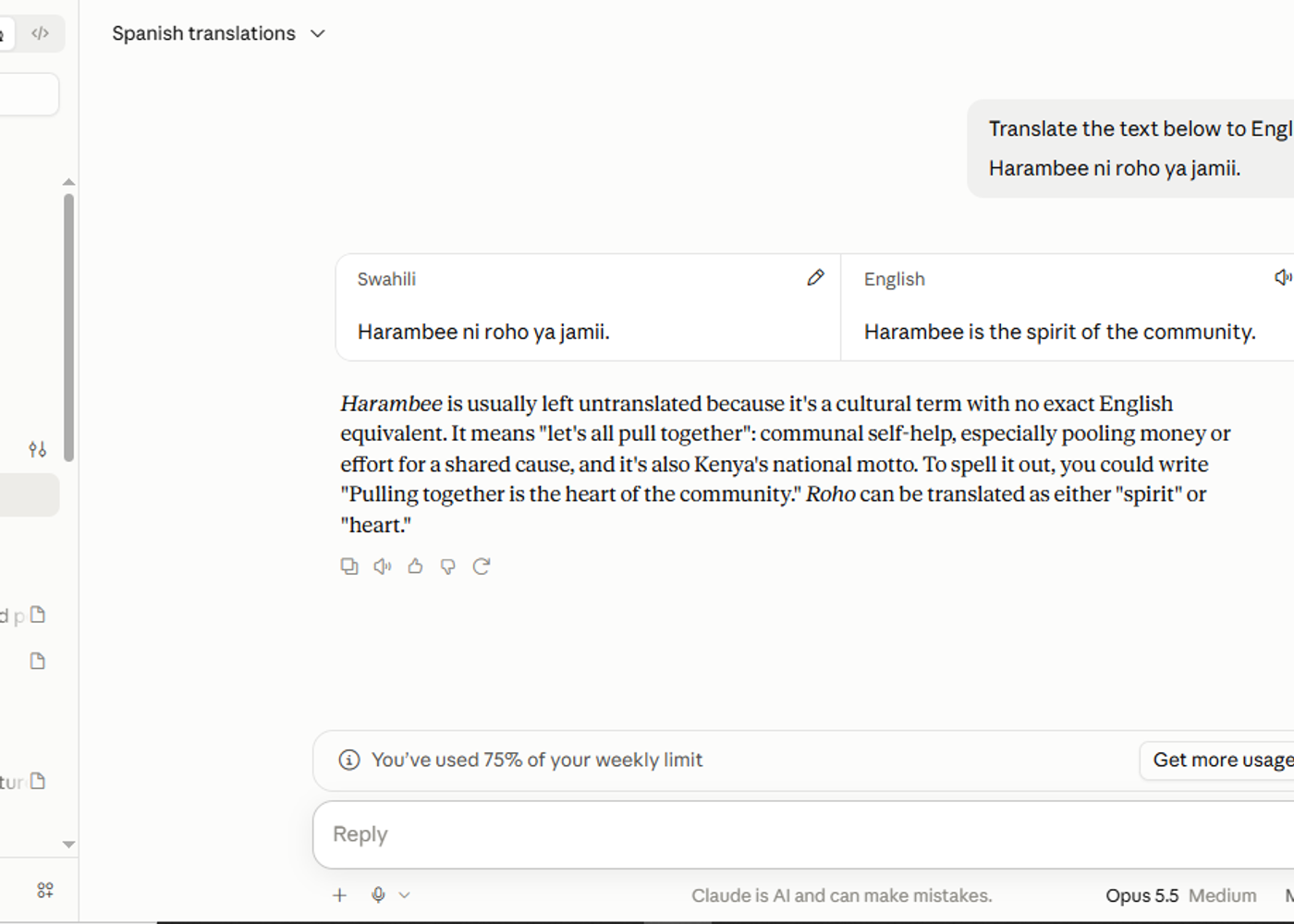
The same gap showed on a condolence line, "Pole sana kwa msiba wenu; tuko pamoja." The others rendered it accurately. Claude unpacked the weight of "msiba" as a bereavement and "tuko pamoja" as "we are with you, you are not alone in this." For a language this culturally dense, that difference is not a nicety. It is the difference between sounding like a foreigner reading a phrasebook and sounding like you understand.
Sheng, the Real-World Register Test
If proverbs test culture, Kenyan Sheng tests the street, the living, code-switching, slang-soaked register that most translation tools historically turned into nonsense. I gave them a line of it: "Niaje boss, uko poa? Tuonane kesho mtaani, tupatane na hao majamaa." All four landed the casual tone. DeepL offered "meet up tomorrow on the street... with those lads", Google "meet in the neighborhood... with those guys", and ChatGPT read the most naturally of all, "What’s up, boss, you good? Let’s meet up in town tomorrow and link up with those guys." None of them embarrassed itself, which, a few years ago, every one of them would have. Sheng is no longer a wall; it is just a question of which tool sounds most like a person.
What This Says About AI and the World’s Other Languages
The real story here is bigger than a tool comparison. For a language like Swahili, machine translation has quietly crossed from unusable to accurate, and that is a genuine shift for the hundred-million-plus people who speak it and have spent years being an afterthought in these tools. But the second finding matters more. Accuracy was never the hard part. The cultural gap, knowing that harambee is a national ethic and that "pole" carries more than "sorry", is the hard part, and only the most capable large language model consistently bridges it. The tools can now carry your words in Swahili. You still need the smartest one in the room to carry your meaning.
| Tool | Price | Best for |
|---|---|---|
| Claude | Free tier; Pro from ~$17/mo | Swahili where culture and nuance matter; it explains, not just translates |
| DeepL | Free; Pro available | Fast, clean, idiomatic Swahili, the real coverage surprise |
| Google Translate | Free | Broad, accurate everyday Swahili; goes literal on proverbs |
| ChatGPT | Free; paid from ~$5/mo | The most natural Sheng and colloquial register |
The rule that still holds
Even here, and even with Claude, the output is a draft. For anything that matters, in Swahili or any language, a machine translation is a strong starting point for a native speaker to check, not a finished document to send. The tools have earned your trust as a first draft, not your signature.
Tips for Translating Swahili with AI
- Do not assume your tool lacks Swahili. DeepL and the rest cover it now, and well.
- For proverbs and cultural terms, use an LLM and ask it to explain, not just translate. A correct literal rendering can hide a lost meaning you will never notice.
- For fast everyday Swahili, DeepL or Google are perfectly good; keep the heavy, culturally loaded stuff for Claude or ChatGPT.
- Always have a native speaker check anything important. The tools are good enough to fool you, which is exactly why you should not let them.
This grew out of a four-way translation test; for the full head-to-head across languages, see DeepL vs Google Translate vs ChatGPT vs Claude. To match a tool to a task, use the recommender.
FAQ
What is the best AI translator for Swahili?+
In my native-speaker test, all four were accurate, but Claude was the only one that reliably understood cultural weight, explaining proverbs and terms like harambee rather than just swapping words. For fast everyday Swahili, DeepL and Google are perfectly good.
Does DeepL support Swahili?+
Yes, and that was the big surprise. DeepL is known for European languages but now handles Swahili well, including idiomatic phrasing. You no longer have to assume it is out.
Can AI translate Kenyan Sheng?+
Far better than it used to. All four tools caught the casual register of a Sheng sentence, with the LLMs (especially ChatGPT) reading most naturally. A few years ago this would have come out as gibberish.
Is AI translation of Swahili accurate?+
On plain meaning and even on hard grammar like noun-class agreement, yes, genuinely. The remaining gap is cultural nuance, where only the most capable models consistently carry the meaning rather than just the words. Always have a native speaker check important work.